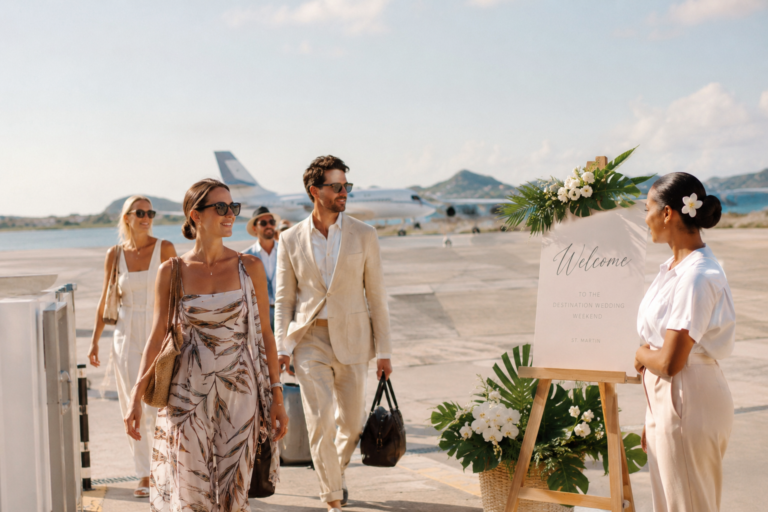
A beautiful wedding weekend can begin to feel strained long before the ceremony if guests are scattered across an island, checking into unsuitable rooms, or trying to arrange late-night taxis in a place they do not know. Destination wedding accommodations for guests are not simply a booking task. They set the tone for how cared for everyone feels from the moment they arrive.
For a close-knit celebration in St. Martin, Mexico, Italy, or elsewhere in the Caribbean, the right accommodation plan creates both ease and atmosphere. It gives guests a place to settle, connect, and enjoy the destination beyond the wedding itself. The goal is not to place every person in identical rooms. It is to make the choices feel considered, clear, and appropriate to the group.
Start With the Shape of the Celebration
Before choosing hotels, villas, or resorts, consider how you want the weekend to unfold. A wedding centered around a private villa has different accommodation needs than one based at a coastal resort or a palazzo in Italy. If the welcome dinner is in a historic town, the ceremony is on a beach, and the farewell brunch is at a private estate, proximity and transportation deserve as much attention as the rooms themselves.
Guest count matters, of course, but so does the composition of the group. Parents may value quiet, convenience, and an elevator. Friends may happily trade a larger room for a lively property near the beach clubs or late-night restaurants. Families traveling with children need practical layouts, reliable meal options, and a realistic sense of how easy it is to get around with strollers and car seats.
There is no virtue in asking everyone to stay at the same property if that property cannot serve them well. In fact, one of the more gracious approaches is often a small, carefully chosen collection of options: a primary hotel where most guests stay, a nearby alternative at a lower price point, and a few private residences or suites for families and the wedding party.
How to Choose Destination Wedding Accommodations for Guests
The most appealing property on a website is not always the best home base for a wedding weekend. Look beyond photographs and ask how the stay will work in real life. Is the property near your event venues? Is there enough inventory for your dates? Can guests easily arrive after an international flight? Will the group have places to gather without turning a hotel lobby into an accidental welcome party?
In St. Martin, for example, two properties may look close on a map yet be separated by roads that feel very different after dark or during busy periods. In Italy, the romance of staying inside a hilltop village can come with winding streets, limited parking, and luggage logistics that need a proper plan. In Mexico and across the Caribbean, a beachfront setting may be perfect for a few days of leisure, but airport transfer times and the availability of evening transportation should be understood before invitations go out.
A thoughtful accommodation recommendation accounts for the destination as it is, not as a map pin suggests it should be. This is where local knowledge has a quiet but meaningful effect on the guest experience.
Prioritize location over novelty
An extraordinary property that requires every guest to spend 45 minutes in a car before and after each event may not be the right choice. Sometimes it is. If the villa itself is the heart of the wedding and the gathering is intentionally private, the journey can be part of the experience. But if your vision includes impromptu breakfasts, afternoons by the water, and a dinner that goes on longer than planned, keeping guests within a comfortable radius is often worth more than a dramatic but isolated view.
Offer a range without creating confusion
Too many options can make guests feel as though they have been handed a research project. Three well-explained choices are generally more helpful than a long list of vaguely suitable hotels.
For each option, communicate the personality of the stay: the best choice for couples wanting to be near the action, the most comfortable option for families, or the private villa ideal for a multigenerational group. A short, candid explanation is more valuable than excessive hotel descriptions. Guests do not need a travel brochure. They need confidence that they are choosing wisely.
Be clear about what is reserved and what is suggested
A room block, contracted allotment, courtesy hold, and recommended hotel are not interchangeable. The distinction affects both your guests and your budget.
A contracted block can offer rate protection and priority access during popular travel dates, but it may carry financial responsibility if rooms are not booked. Courtesy holds can be useful but tend to expire quickly, particularly during festive seasons and major events. For smaller weddings or destinations with a broad range of quality accommodations, a preferred-rate arrangement or a simple recommendation may be the more sensible route.
The right structure depends on the dates, the property, and how decisively your guests tend to book. Couples sometimes assume a room block is always the polished choice. It is only polished when its terms genuinely serve the group.
Make Transportation Part of the Accommodation Plan
The distance between guest rooms and wedding events is never just a logistical detail. It determines whether people arrive relaxed, whether grandparents stay for the final toast, and whether your friends can enjoy a second glass of Champagne without opening a rideshare app in an unfamiliar place.
For accommodation planning, map every essential movement: airport arrivals, welcome events, wedding-day transportation, late-night returns, and departures after the farewell brunch. Then account for the less obvious needs, such as guests arriving a day early, flights landing at different times, or a family needing a car seat.
Centralized shuttles are often the best answer when a meaningful number of guests are staying in one or two areas. They offer clarity, prevent parking complications, and allow the group to move together. Yet they are not automatically necessary. In walkable Italian towns, or at a resort where most events take place on property, a well-organized schedule and a few on-call vehicles may be enough.
The key is to avoid leaving transportation as an afterthought. A beautiful villa on a hillside and a late-night party can coexist perfectly. They simply require a return plan that is as reliable as the first ride up.
Give Guests Information at the Right Moment
Guests should receive accommodation details early enough to secure favorable flights and rooms, especially for weddings during school holidays, high season, or limited-inventory periods. Save-the-dates are often the right place to share the destination, dates, and the expected booking window. Once accommodations are confirmed, provide direct, uncomplicated instructions.
Your communication should answer practical questions before they become text messages: When should we arrive? Which airport should we use? Is a rental car useful? Are there rooms appropriate for children? What is the closest option to the wedding venue? Is there a deadline to reserve at the group rate?
A wedding website can hold these details, but it should not be the only place guests receive them. A concise accommodation note sent at the right time is a kindness. So is a designated contact for guests who need help deciding where to stay. Couples should not be fielding room-category questions while selecting ceremony music.
Consider the Welcome Beyond the Check-In Desk
The accommodations themselves do not have to carry every hospitality gesture. A small in-room welcome can be lovely, but only if it is practical to deliver and appropriate to the property. A bottle of water, a thoughtful local snack, a weekend itinerary, and one useful destination detail can say more than an overstuffed gift bag that guests must carry home.
In the Caribbean, that might mean sunscreen, a local sweet, and a note about the beach conditions or island customs. In Italy, perhaps it is a regional treat, a useful phrase or two, and a reminder that dinner begins later than many American guests expect. The best gestures feel rooted in place rather than branded for the sake of it.
It is equally gracious to anticipate comfort. Let guests know whether evening events will be outdoors, whether cobblestones or sand are involved, and whether the weather changes quickly after sunset. These are small details, but they spare your guests the feeling of having packed for a different wedding than the one they have arrived to enjoy.
When a Villa Is the Center of the Weekend
Private villa celebrations offer a special kind of closeness: morning coffee with family, a poolside afternoon that needs no reservation, and a final dinner under the stars without anyone watching the clock. They also call for especially careful accommodation planning.
For couples planning a private villa celebration in St. Martin, our sister brand, Anniboni, focuses on the complete experience—from the setting and accommodation choices to the practical details that bring guests together. For celebrations elsewhere, The Destination Vows helps couples coordinate the planning, guest logistics, and experiences that make a destination wedding feel effortless.
The most memorable destination weddings rarely feel over-managed to the people attending them. Guests remember warm turquoise waters, a table full of familiar faces, and the pleasure of being welcomed into a place that has been thoughtfully chosen for them. Give them a clear place to land, an easy way to arrive, and enough guidance to feel at home. The rest of the weekend can unfold beautifully.
Planning a destination wedding and not sure where your guests should stay?
At The Destination Vows, we help couples think through the details that make a destination wedding feel effortless—from choosing the right setting and coordinating accommodations to arranging transportation and creating a weekend everyone can enjoy.
Planning a wedding in the Caribbean, Mexico, Italy, or beyond?