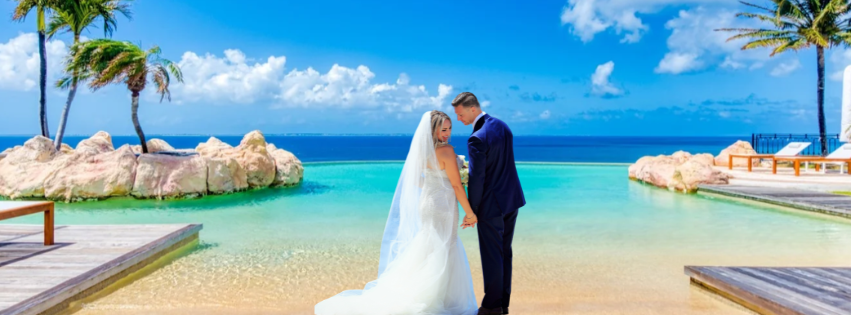
People ask me, fairly often, why I plan weddings across Italy, France, Mexico, and the Caribbean and still choose to live on a thirty-seven-square-mile island most of my American clients can't find on a map without zooming in twice. Here's the honest answer: St. Martin / St. Maarten is the only place I work where I don't have to imagine the venue. I can walk to it.
This island has two names, two governments, two languages, and — depending who you ask — two completely different personalities sharing one extremely small piece of land. Most planners who "do Caribbean weddings" treat it as one stop on a regional portfolio. I treat it as home. That distinction matters more than people expect once their wedding day actually arrives.
So let me show you what I mean. Where the real villas are. What the French side gives you that the Dutch side doesn't, and vice versa. And why, for a wedding this important, "I researched this online" is never quite the same as "I live three minutes from there."
One Island, Two Seas, Two Entirely Different Weddings
The detail every other Caribbean guide leaves out.
Here's the thing almost nobody tells couples researching the Caribbean: St. Martin / St. Maarten sits on two seas — the calm turquoise Caribbean on one coastline, the wilder, bluer Atlantic on the other. Most islands give you one kind of water and one kind of light. This one gives you a choice, often within a fifteen-minute drive.
Layer onto that the island's split identity — the French side, Saint Martin, moving at an unhurried European pace with long lunches and architecture that leans Provençal; the Dutch side, Sint Maarten, livelier, more American in its energy, with a harbor full of yachts and a nightlife the French side doesn't bother competing with. Most couples don't realize they're choosing between two distinct wedding atmospheres until they're standing on both coasts in the same afternoon.
"I had a bride who insisted she wanted 'classic Caribbean energy' — and what she actually meant, once we walked both sides together, was the French side at golden hour with a glass of rosé. Her fiancé wanted the boats, the buzz, the Dutch side marina at sunset. We gave them a French-side ceremony and a Dutch-side reception. Forty-minute drive. Two completely different moods. Neither of them compromised on anything."
The Neighborhoods That Make a Wedding Villa Worth Booking
Not every postcard view comes with a property built to host your day.
On the French side, Terres Basses is the address that matters most — a gated peninsula of expansive estates along Baie Longue and Plum Bay, the kind of privacy and scale that makes a wedding feel like it's happening inside a postcard nobody else gets to see. Orient Bay brings energy and walkable dining for couples who want their guests entertained beyond the villa gates. Anse Marcel and Mont Vernon offer something quieter — sheltered, hillside, panoramic, ideal for ceremonies that want the view to do the talking.
On the Dutch side, Pelican Key and Indigo Bay deliver ocean-view villas close enough to Simpson Bay's restaurants and nightlife to feel convenient, without sacrificing privacy. Cupecoy adds a sleeker, more architectural feel for couples after something contemporary rather than colonial. Oyster Pond, tucked toward the island's eastern edge, gives you hillside seclusion with views stretching toward the neighboring islands — genuinely one of the most underrated wedding settings on either side.
Listing photos rarely tell you which neighborhoods actually allow live music past a certain hour, which beaches get crowded with day-trippers by 11am, or which "oceanfront" villas are oceanfront in name only, separated from the water by a public footpath. This is exactly the kind of detail that only shows up after you've been there — not once, but repeatedly, across seasons.
What I Actually Check Before Recommending a Villa Here
- Noise ordinances and curfews specific to that neighborhood, not the island generally
- Whether the "private beach" is actually private, or simply quiet on the day I visited
- Power capacity for a band, lighting rig, and a kitchen running for sixty
- How the light moves across the ceremony space between 4pm and sunset
- Whether the villa's team has hosted a wedding before — or only ever a family vacation
What Living Here Actually Buys You on Your Wedding Day
It's not a portfolio. It's a phone that gets answered.
Most planners who offer St. Martin / St. Maarten weddings fly in for the booking and fly in again for the wedding itself. I live here. That means when a vendor goes quiet two weeks before your date, I'm not sending an email into a void from another time zone — I'm driving over. It means I know which florist actually delivers what they promise during peak season, not just who has the prettiest Instagram. It means I've watched this island through hurricane season and high season, through quiet Tuesdays and chaotic regatta weekends, and I know which weeks genuinely work for a wedding and which ones only look good on a calendar.
It also means cultural fluency that doesn't come from a guidebook. Knowing how business actually moves between the French and Dutch sides — different languages, different bureaucracies, different rhythms, sometimes within the same afternoon. Knowing which permits matter and which are formalities. Knowing, because I grew up between Venice and the Caribbean myself, exactly what it feels like to plan a wedding as an outsider looking in — and building my entire approach around making sure my couples never feel that way.
"A couple once asked me, very politely, why they should work with someone local instead of a bigger agency with a flashier website. I told them: because when your photographer's flight gets delayed eight hours the morning of your wedding, you don't want someone googling backup photographers in St. Maarten. You want someone who already has three on speed dial, because she's used them before, because she actually lives here. That's not a sales pitch. That's just what the job requires."
French Side vs. Dutch Side, For Your Wedding
| Category | French Side (Saint Martin) | Dutch Side (Sint Maarten) |
|---|---|---|
| Overall Energy | Unhurried, European, refined | Lively, social, American-paced |
| Top Villa Areas | Terres Basses, Orient Bay, Anse Marcel | Pelican Key, Indigo Bay, Oyster Pond |
| Coastline | Mostly Caribbean & Atlantic mix | Primarily calm Caribbean Sea |
| Dining Scene | French-Caribbean fine dining | International & marina-side |
| Best Guest Count | 20–70, intimate & elegant | 30–100, social & flexible |
| Signature Feel | "We escaped to the South of France" | "We're at the best party on the island" |
The island doesn't need to be sold to you. It just needs someone who actually knows it to show you where to look.
St. Martin / St. Maarten rewards couples who go past the surface — past the postcard beach shot, past the "best of the Caribbean" listicles that treat every island the same. There's real range here, real depth, two sides and two seas and a hundred small details that only reveal themselves to someone who's actually walked the ground.
That's the work I do. Not recommending villas from a directory, but knowing this island the way you know your own neighborhood — which is, conveniently, exactly what it is to me.
Frequently Asked Questions About Villa Weddings in St. Martin / St. Maarten
Should I choose the French side or the Dutch side for my villa wedding?
It depends on the atmosphere you want. The French side (Saint Martin) offers a quieter, more refined European feel — ideal for intimate, elegant celebrations around Terres Basses, Orient Bay, and Anse Marcel. The Dutch side (Sint Maarten) is livelier and more social, with strong villa options around Pelican Key, Indigo Bay, and Oyster Pond, and easier access to marina-side dining and nightlife. Many couples choose a ceremony on one side and a reception on the other — the entire island can be crossed in under 45 minutes.
How many guests can a villa wedding in St. Martin / St. Maarten accommodate?
Most private villas on the island comfortably host 20–80 guests, with the largest estates in Terres Basses and select Dutch-side properties accommodating up to 100. For larger guest lists, a villa cluster — your primary property paired with one or two neighboring villas for accommodation — is a common and effective solution.
What is the best time of year for a villa wedding on the island?
December through April is the dry season and the most popular window, with the most reliable weather and lower humidity. Late April and May offer excellent conditions with fewer crowds and better rates. Hurricane season runs June through November — weddings are still possible during these months with proper planning and travel insurance, but couples planning during this window should build in extra contingency.
Why work with a specialist who lives on the island instead of a planner who visits occasionally?
Real-time, on-the-ground problem solving is the difference. A planner based on St. Martin / St. Maarten can respond same-day to a vendor issue, has personally vetted the villas they recommend across multiple seasons, and understands the practical realities of moving between the French and Dutch sides — different languages, permits, and business customs that affect how smoothly your day comes together. This kind of knowledge is built through presence, not research.
Do I need separate permits for the French side versus the Dutch side?
Yes — Saint Martin (French) and Sint Maarten (Dutch) operate under different governments with separate legal and permitting processes, even though the island is physically one landmass. This applies to ceremony permits, vendor licensing, and in some cases customs for shipped items. Most couples choose a symbolic ceremony on whichever side suits their vision and handle the legal marriage at home beforehand, which simplifies this considerably — a destination specialist familiar with both sides can guide you through whichever path you choose.
Your St. Martin / St. Maarten Villa Wedding, Planned by Someone Who's Already There
No imagining the venue. I already know it.
Start the Conversation
Great content! Keep up the good work!
Thank You! Happy you enjoy it!